
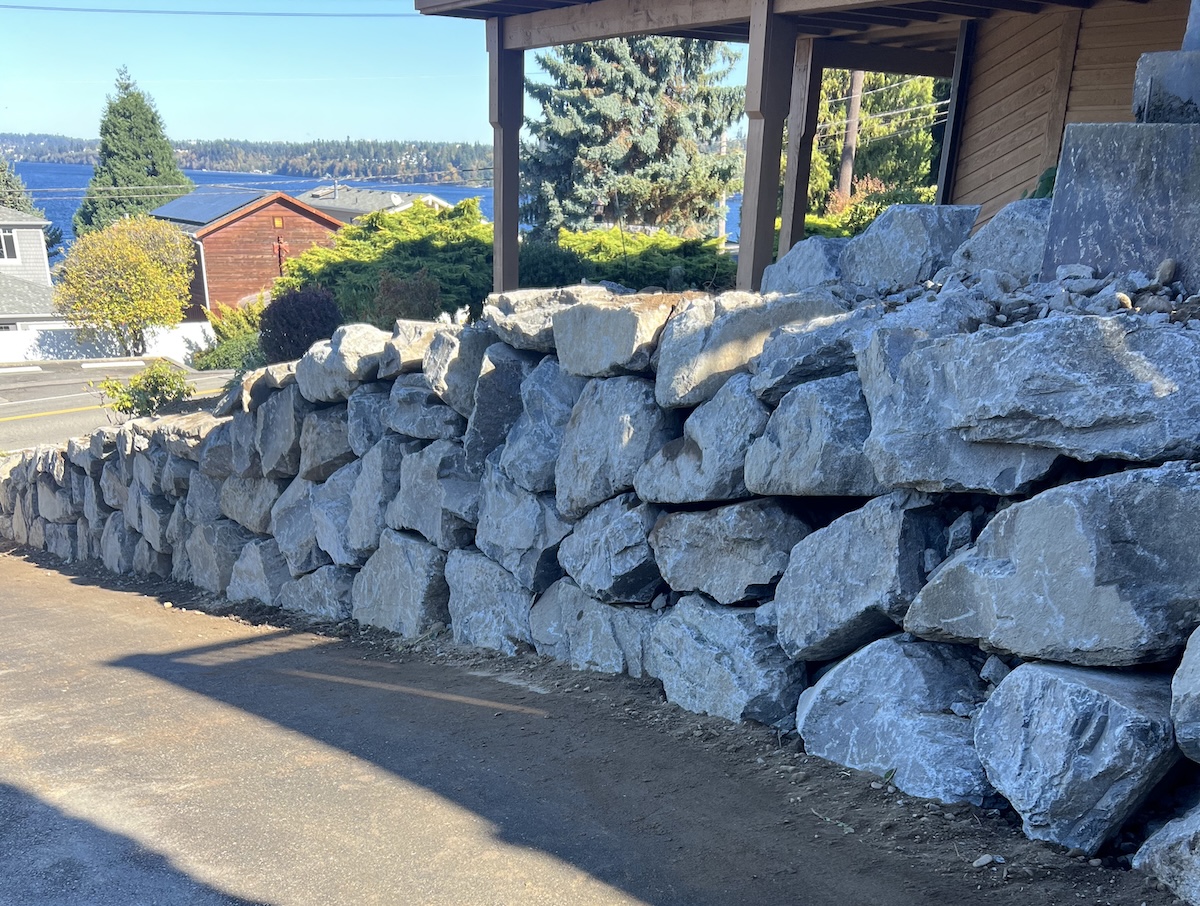
Rock Retaining Walls: Cost, Lifespan, and What to Know Before You Build
Why Homeowners in the Seattle Area Ask These Questions
How much should a rock retaining wall cost, and how long should it actually last? These are some of the most common questions homeowners ask when planning a retaining wall project. In the Seattle area, where heavy rain, sloped properties, and shifting soil are common, the answers matter even more.
At Rainier Rockeries, Angel and the team have these conversations every day. Most questions come down to the same three things: how much it costs, how long it will last, and what actually determines whether a wall holds up for decades or starts failing early.
That’s exactly what this guide is meant to break down: cost, lifespan, and everything you should realistically understand. And if you want to see how professional installation is approached, you can also explore our Rock Retaining Walls service page for a clearer look at the process.
What Are the Disadvantages of Rock Retaining Walls?
Rock retaining walls are strong, durable, and visually appealing, but they do come with trade-offs that homeowners should understand.
They Require More Skilled Labor Than Block
Rock retaining walls are not a typical DIY project. Unlike modular block systems, natural stone placement depends heavily on experience and the ability to read the site as the work progresses. Because of that, labor costs tend to be higher, and the quality of the contractor becomes much more noticeable.
Engineering and Permitting Is Less Straightforward
Block systems are designed to be uniform, which makes engineering calculations more predictable. Natural stone, on the other hand, introduces irregular shapes and sizes, which means load distribution often needs more site-specific evaluation.
Moreover, in Washington, any retaining wall over 4 feet still requires engineering and permits regardless of material. You can review the general rules through the King County permitting requirements.
Drainage Planning Is Even More Critical With Rock
Rock walls naturally have small gaps between stones. While those gaps help with flexibility and drainage, they also mean water can move through the face of the wall. Therefore, proper drainage design is essential here, as it directly affects long-term performance.
This is something we’ll look at more closely in the lifespan section, since water management is one of the biggest factors in how long any retaining wall actually lasts.
Washington’s Conditions Make These Tradeoffs Less Forgiving
In Washington, glacial till often holds moisture for long periods, and the region sees heavy rainfall from October through March. On top of that, freeze-thaw cycles during winter can slowly stress poorly built walls.
These conditions do not make rock a bad choice, but they do raise the stakes. A skilled contractor can build a rock wall that performs extremely well here, and less experienced work tends to fail faster in this kind of environment than it would in a drier climate.
If problems develop over time, addressing them early with Retaining Wall Repairs can help prevent minor issues from becoming major structural failures.
Is a Stone Wall Cheaper Than Brick?
This question usually comes down to understanding different retaining wall systems rather than literal brickwork versus stone.
What Most People Are Really Comparing
When people say brick in this context, they are almost always referring to manufactured concrete block systems such as Belgard, Baselite, or Mutual Materials. In reality, true fired brick is rarely used for retaining walls in this region because it is not designed to handle soil pressure in the same way.
Where Each Material Has the Cost Advantage
Natural rock can sometimes be more cost-competitive on smaller projects, especially when the stone is locally sourced and the site has good access for equipment and delivery.
However, as project size increases, block systems tend to become more economical. This is because modular installation scales more efficiently, and contractors can often take advantage of volume pricing. Even so, neither option is universally cheaper; it really depends on the site and scope.
What Actually Moves the Number
The biggest cost drivers are not the materials themselves. Instead, labor, site access, and drainage requirements have a much larger impact. Angel often points out that a cheaper wall built without proper drainage or installation planning usually ends up costing more over time.
If you are deciding between materials, it’s worth exploring both Block Retaining Wall and Rock Retaining Walls to see which solution best fits your property and budget.
How Expensive Is a Rock Retaining Wall?
There is no honest, one-size-fits-all number for a rock retaining wall without first looking at the property. But to make it easier to understand, we are breaking down some key factors that actually influence the final cost.
The 7 Factors That Determine the Final Price
Wall height — Height is one of the biggest cost drivers. Once a wall goes over 4 feet, it typically triggers engineering and permit requirements in Washington. That adds both design time and construction detail, which increases overall cost.
Wall length — Longer walls naturally cost more because they require more materials and labor. However, larger projects often bring the per-square-foot cost down slightly since crews can work more efficiently at scale.
Stone type and sourcing — In addition, the type of stone and where it comes from plays a big role. If the material needs to be hauled long distances or is harder to source locally, both cost and timeline can increase.
Site accessibility — If equipment cannot easily reach the work area, everything slows down, and in some cases, labor costs can double or even triple because of manual handling.
Soil conditions — Areas with glacial till or heavy clay take longer to excavate and prepare properly, which adds time before the wall itself can even begin.
Drainage requirements — Drainage is another non-negotiable part of the build. Proper water management behind the wall is essential, and skipping or underbuilding this step is one of the main reasons walls fail early.
Demo and removal — Finally, if there is an existing failing wall, it has to be removed first. That means extra labor, hauling, and disposal before new construction can even start, which adds both time and cost.
What to Expect Per Square Foot in the Seattle Area
When it comes to overall pricing, rock retaining walls generally sit at the higher end of the retaining wall cost range due to the amount of skilled labor involved. However, larger projects often become more efficient, which can bring the per-square-foot cost down. To get a clearer picture of what works best for your property, it’s worth exploring both Rock Retaining Walls and Seattle retaining walls to see how different systems are designed for local conditions.
How Long Do Rock Walls Last?
Rock walls can often outlast the homes they sit behind, but only if proper drainage is designed and maintained from the very beginning.
The Honest Answer: 50 to 100 Years If Drainage Is Right
Natural stone itself is extremely durable. It does not rot, rust, or break down the way many other building materials do. Because of that, properly built and well-drained rock retaining walls can easily last 50 years or more.
In fact, the material is rarely what limits the lifespan. Instead, it almost always comes down to how water is managed behind and through the wall.
What Actually Kills a Rock Wall Early
When rock walls fail early, the cause is usually water pressure building up behind them. This is known as hydrostatic pressure, and it happens when water gets trapped in the soil, effectively doubling the weight pushing against the wall.
On top of that, freeze-thaw cycles make the problem worse. Each winter, trapped water expands and contracts, slowly forcing stones out of place. Without proper drainage, this cycle repeats every season, and as Angel has seen on real job sites, some walls can fail in as little as two years when drainage is completely overlooked.
What Proper Drainage Behind a Rock Wall Looks Like
Because of these risks, drainage design becomes the most important part of the system. A properly built rock wall typically includes five key components working together: a perforated drain pipe at the base, clean crushed rock backfill, filter fabric, weep holes through the face of the wall, and careful surface grading above.
Each part has a specific role, but together they relieve water pressure and keep the structure stable. In other words, this is what separates a wall that lasts 50 years from one that becomes a costly problem much sooner.
Signs Your Existing Rock Wall Is Already in Trouble
Even so, issues do not usually appear all at once, as they build up over time. For example, a leaning or bulging face is often one of the first warning signs that pressure is increasing behind the wall. Similarly, gaps opening between stones, erosion at the base, or water seeping through after rain all point to drainage problems.
If any of these signs appear, it’s important to address them early. Professional Retaining Wall Repairs can often resolve minor issues before they lead to failure, while more serious damage may require Reinforced Walls services to restore lasting stability.
Rock Wall vs. Block Wall — Which One Is Right for Your Property?
Now that we have covered cost, lifespan, and long-term performance, the next question is which type of retaining wall is actually the better fit for your property. The answer depends on several factors, including the look you want to achieve, the demands of the site, and your overall budget.
When Rock Makes More Sense
Rock retaining walls are often the better choice for natural or wooded landscapes where the goal is to complement the surrounding environment. At the same time, rock is also an excellent option for smaller decorative walls. Many homeowners also choose natural stone because it offers a timeless look and rarely feels outdated, even decades later.
When Block Makes More Sense
On the other hand, block retaining walls tend to be the better option for larger projects where efficiency and consistency become more important. Since the blocks are manufactured to uniform sizes, installation is typically faster and more predictable, which can help reduce the cost per square foot.
In addition, block systems work especially well when projects involve tighter engineering requirements. If you are looking for a durable solution that fits within a more defined budget, exploring a Block Retaining Wall may be the right place to start.
What Never Changes Regardless of Material
No matter which material you choose, some essentials remain exactly the same. For example, proper drainage is always essential, engineering requirements still apply when needed, and working with an experienced contractor is critical, especially in Washington.
Because of that, the material itself is only one part of the equation. In the end, the quality of the design and installation will have a much greater impact on how well the wall performs over time.
Talk to Someone Who Has Built Hundreds of Rock Walls in King County
Free On-Site Estimates Across Seattle, Bellevue, Renton, Issaquah, Sammamish, and Beyond
To move from planning to action, it helps to have an experienced contractor walk your property and assess the actual conditions before any decisions are made. That’s why Angel personally visits every site before providing a quote, making sure the recommended design is the right fit for your landscape and built for long-term performance.
At Rainier Rockeries, we offer free on-site estimates throughout King County and Pierce County.
If you are ready to discuss your project or have questions about your options, you can call 425-260-1595 to schedule your consultation.