Planning a Retaining Wall in Seattle? Here’s What Affects the Price
A Q&A with Angel, Owner and Lead Retaining Wall Technician at Rainier Rockeries
If you’ve ever called a retaining wall contractor and asked “how much does this cost?” — you already know the answer is never simple. That’s not a dodge. It’s just the reality of a project that touches your land, your soil, your slope, and your budget all at once.
We sat down with Angel, the owner and lead technician at Rainier Rockeries, to break down exactly what goes into pricing a retaining wall in Seattle and the surrounding areas. With 20+ years in the field, Angel has seen it all — from backyards only accessible by hand to emergency collapses that needed immediate attention. Here’s what he wants every homeowner to understand when they get a quote.
Q: Is a retaining wall really that different from other landscaping projects?
Angel: Many retaining wall projects are not for aesthetics alone — it’s more practical intent. I get a lot of emergency calls for repairs. It’s like a surgery to a main organ you need, not cosmetic like a pavers or turf project. When a wall fails, it can affect your yard, your home’s foundation, even your neighbors. So the stakes are different, and the work reflects that.
Q: What are the main factors that determine what a retaining wall will cost?
Angel: Seven factors influence the cost of building a retaining wall.
1. Wall height is one of them. Tall walls usually cost more because the material increases and stronger structural reinforcement is sometimes required. Anything more than 4 feet will actually require engineering, you’ll need a permit for that.
2. Wall length is another. The longer the wall, the more expensive.
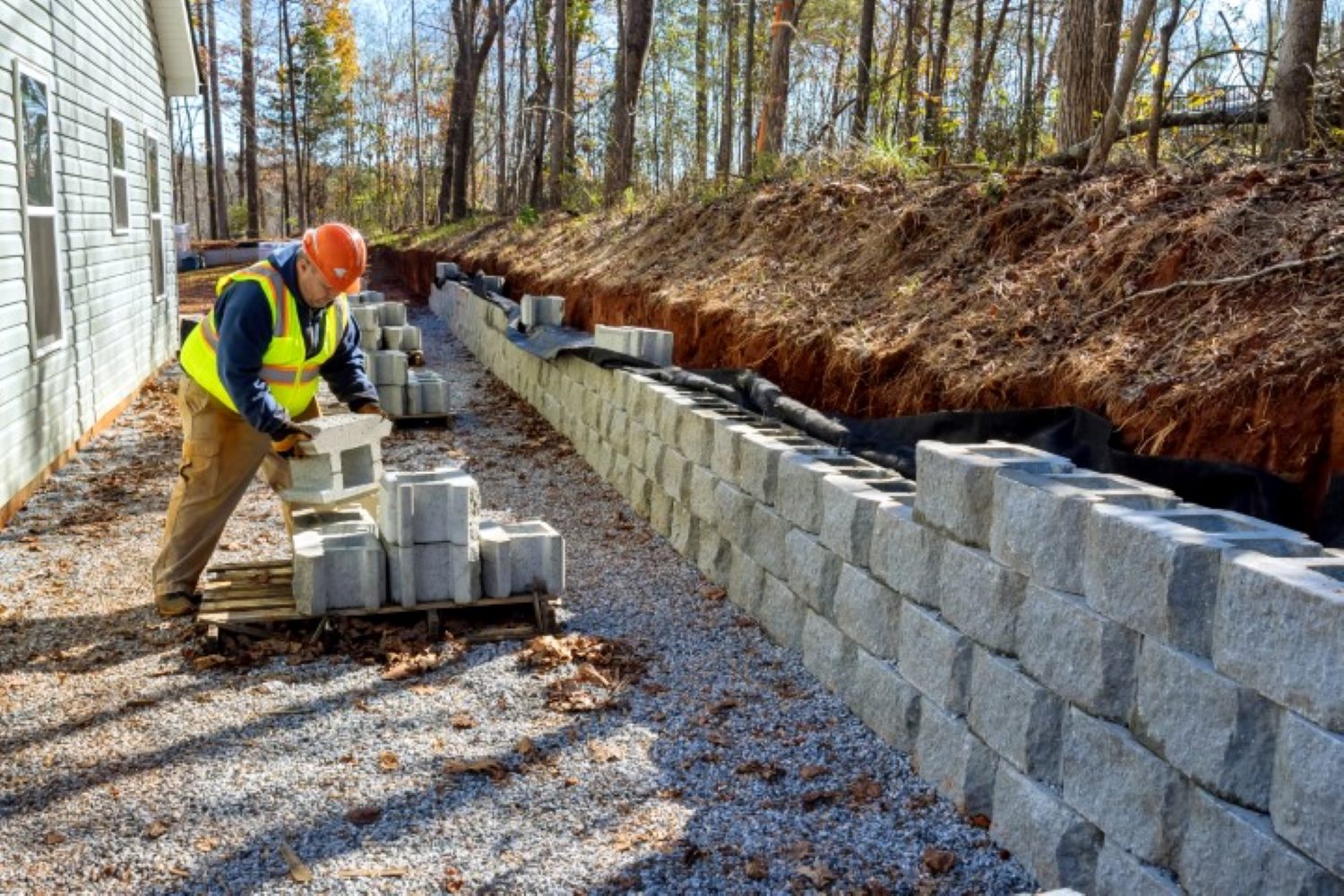
3. Material type is the number one reason prices go up or down. There are different designer blocks, segmental retaining wall systems — different types of block can change the cost significantly.
4. Site accessibility is very important. One project can have the same square footage as another, but one has access for equipment and the other doesn’t, and that can change everything. Tighter spaces, steep slopes, urban sites — limited equipment access means a labor-intensive project that costs a lot more.
5. Soil conditions can also change the work. Some soil is just harder to work around.
6. Drainage requirements are critical, and proper drainage can also affect the cost, but it’s non-negotiable if you want a wall that lasts.
7. And finally, existing site conditions — whether there’s an old wall to remove, trees in the way, debris to haul out — all of that factors in.
Q: How does the material a customer picks actually change the price?
Angel: That is actually a very simple answer. If the length of a retaining wall is 50 feet or 100 feet and a customer says, “I want regular Mutual Material manor stone blocks” — which is less expensive — the price per square foot stays consistent. But if the customer wants Belgard high-quality blocks, or designer options — there are plenty out there — it does change the price significantly. Some blocks cost six or seven dollars a piece, but then designer blocks like segmental or Diamond Flat Piece options can run a lot more. Some of those also have a different installation process, which means more time, more labor, and a higher material cost.
You can have the exact same wall, same dimensions, same location, and change the material and double the price. That’s how much material matters.
For block walls, Rainier Rockeries works with vendors including Belgard, Baselite, and Mutual Materials.
Q: You mentioned site accessibility, can you explain how much that actually moves the needle on price?
Angel: Absolutely. If a customer already has an old retaining wall that is collapsing, and we have to go in and remove the whole thing, that causes a significant amount of additional cost right there. We’re removing old rocks, old blocks, maybe concrete. That can take a couple of days of work, plus hauling fees.
Compare that to going to a slope where a customer says “I need a wall there” — you’re just preparing the site. Less time, no material hauling. It can be cheaper.
But the biggest factor is equipment access. If a customer’s backyard has no equipment accessibility, a $1,000 project with access could turn into $2,500. Now you’re doing everything by hand, and labor costs a lot — it can triple the time. The same project with equipment access will cost half of what it costs without it. Customers understand that once you explain it.
We have equipment ranging from 4 feet wide up to 8 feet wide, so we assess what we can get in before we ever give a quote.
Q: Does the size of the project affect the price per square foot?
Angel: The longer the project, obviously it’s going to cost more overall. But here’s the thing — sometimes a larger project with better accessibility can actually be done quicker than a smaller project with poor access. So size and cost don’t always scale the way people expect.
And when a project is bigger, we tend to give more of a discount. For example, if a retaining wall is smaller, we might charge $55 or $60 per square foot. But if it’s 1,000 square feet, we might end up doing it at $35 to $40 per square foot — because now there’s more total square footage and we can give a better price per foot. So bigger isn’t always more expensive per square foot. It’s one of the reasons it’s worth getting a quote even if your project feels large.
Q: Let’s talk about drainage. Why does it matter — and how does it affect long-term value?
Angel: Drainage is one of the most critical components of a retaining wall. In fact, most retaining wall failures are actually caused by water buildup, not structural weakness in the wall material itself. Just the failure of drainage.
The reason is hydrostatic pressure. Water traps in the soil and adds literal pressure against the wall. Wet soil can weigh nearly double what dry soil weighs. That added pressure pushes the wall outward, causes cracking, and leads to eventual collapse. And especially with freeze-thaw cycles — when trapped water freezes, that causes serious damage too.
A properly drained wall can last 40 to 50 years. I have seen walls without proper drainage fail in as little as two years.
Good drainage reduces the risk of leaning, sliding, rotating, cracking, and total collapse. It also protects the surrounding area — water buildup can erode soil under the wall, damage nearby foundations, and create sinkholes or washouts.
The common drainage components we use are: a perforated drain pipe, gravel backfill, filter fabric, and weep holes. It’s not optional. It’s the difference between a wall that’s an investment and one that becomes a liability.
We are Based in Maple Valley, WA and Ready When You Need Us
If you’re planning a retaining wall in Seattle, Bellevue, Issaquah, Renton, or anywhere in King County, Rainier Rockeries offers free on-site estimates. Angel and his team will assess your slope, your soil, your access, and your goals — and give you a quote that actually reflects your specific project.
We are here 24/7: Call 425-472-4963
Explore All of Our Services
Wall Services
Rock Retaining Wall
Block Retaining Wall
Retaining Wall Repairs
Reinforced Wall
Hardscape Services
Steps and Risers
Pavers
Artificial Turf
Landscaping